Mobile Auto Dialer for Solar & Mortgage Sales (USA)

Why desktop dialers fail outside sales reps, what the TCPA requires in 2026 after the one-to-one rule was vacated, and what the mobile alternative costs.
Direct answer: solar consultants and mortgage brokers are outside sales reps — the work happens at kitchen tables, job sites and in cars, not at a desk. Desktop power dialers assume the opposite, which is why outside reps either skip the dialer or pay for one they barely open. A mobile dialer that places calls over the rep's own cellular plan removes both the desk dependency and the per-seat licence. What it does not remove is your compliance obligation, which in these two verticals is the highest-risk part of the job.
Correction, August 2026: an earlier version of this page described the FCC's one-to-one consent rule as current law. It is not. The Eleventh Circuit vacated it in Insurance Marketing Coalition v. FCC in January 2025 — before it ever took effect — and the FCC subsequently removed the language and reinstated the prior rules. Consent requirements under the TCPA still apply; the specific one-to-one requirement does not. Verify your position with counsel rather than with any marketing page, this one included.
Why desktop dialers fail outside sales
A power dialer is built around an uninterrupted block: a rep at a desk, headset on, working a list for four hours. That is a real and effective way to sell, and it is not how solar or mortgage sales works.
- Mornings are driving between appointments.
- Middays are at customer homes and job sites where a laptop is impractical.
- The gaps are fifteen minutes in a parked car — enough for eight calls, not enough to set up a workstation.
- Evenings are when consumers actually answer, and by then the rep is nowhere near a desk.
The result is predictable: the licence gets paid and the tool gets used for a fraction of the day it was priced for.
What the compliance picture actually looks like
Solar and lead-generation calling attracts regulatory attention, and the rules move. Getting this right matters more than any dialer feature, so here is what can be stated accurately.
- The TCPA still requires prior express written consent for marketing calls using an autodialer or artificial or prerecorded voice. That has not changed.
- The one-to-one consent rule is not in force. Vacated by the Eleventh Circuit in January 2025 and subsequently removed by the FCC. Any vendor still selling you a product on the basis of that rule is working from stale information.
- Statutory damages are per call. The TCPA provides $500 per violation, rising to up to $1,500 for a willful or knowing violation. Multiply by call volume before deciding this is somebody else's problem.
- Abandoned-call limits apply to multi-line dialing under the FTC's Telemarketing Sales Rule, which is a separate regime from the TCPA and independently enforceable.
- Caller authentication is now standard. Carriers sign calls under STIR/SHAKEN, and the attestation level reflects the originating provider's confidence that the caller is entitled to use the number.
Primary sources: the FCC on call authentication and the FTC's Telemarketing Sales Rule guidance. Our summary is at TCPA compliance and in more depth at TCPA and STIR/SHAKEN. Neither is legal advice.
Who carries the risk
Software can store consent metadata, suppress DNC numbers and log an audit trail. It cannot obtain consent for you, and it is not the regulated party — you are. Any tool marketed as making you compliant is describing the paperwork, not the obligation.
Caller reputation: the mechanism
A call placed from a consumer handset over that carrier's own network is the straightforward attestation case — the carrier issued the number and knows the subscriber. An unfamiliar virtual DID routed through a chain of providers is a harder case, and carrier analytics treat it accordingly.
That is a structural property rather than a feature anyone built, and it is not a guarantee. Attestation is one input among several to the spam-labelling systems carriers and handset apps run, and any number used for aggressive high-volume outbound will accumulate a reputation. Measure your own connect rate before and after rather than trusting a claimed figure.
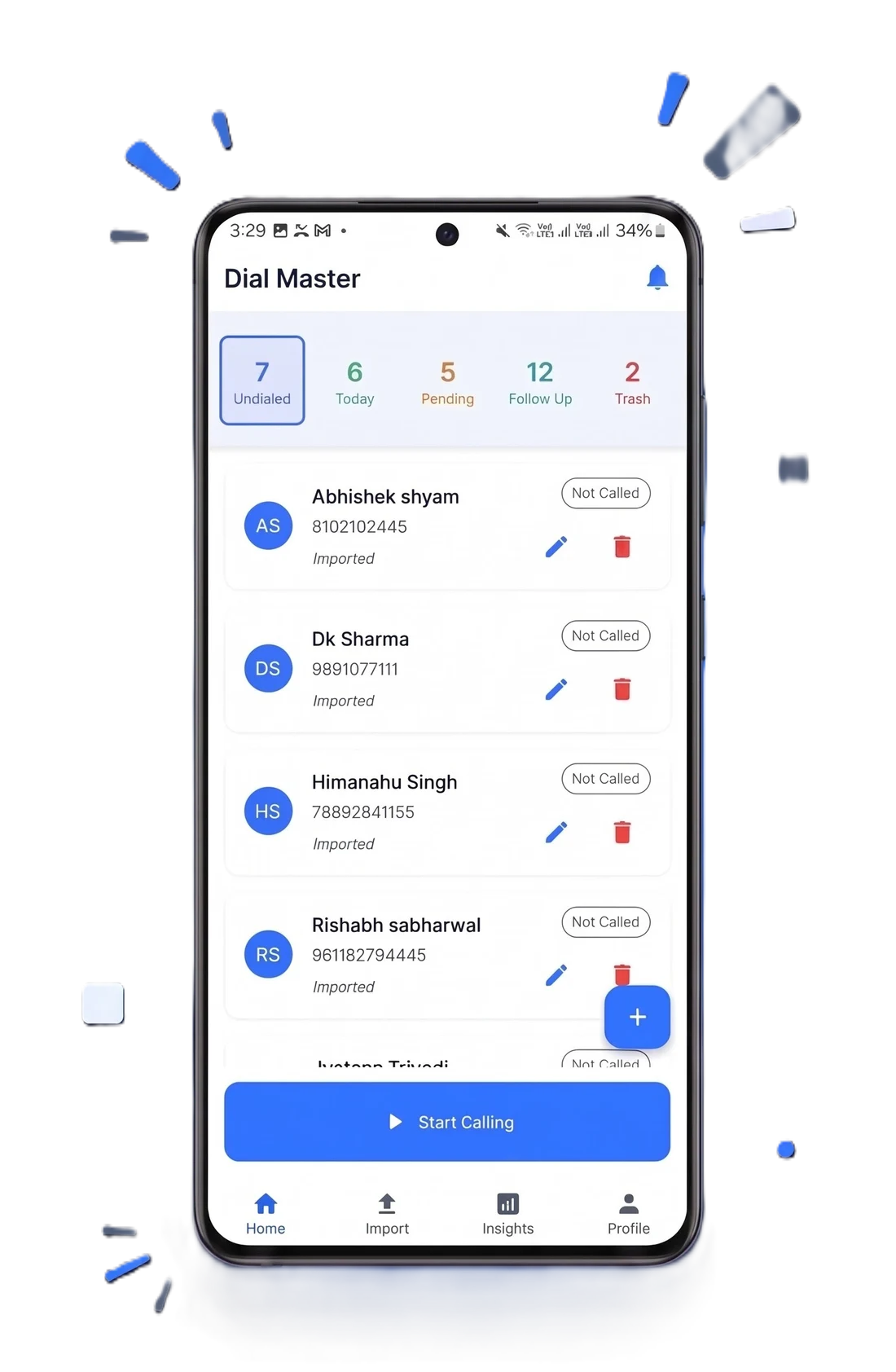
The outside-sales day, structured
- Triage before you drive. Overnight leads sorted in five minutes, hot ones queued. Sorting sophistication matters far less than doing it before the day starts.
- First dial block from the driveway. The queue you built five minutes ago, worked before the first appointment.
- Log the outcome at hang-up, every time. This is the whole discipline. A call without a logged outcome did not happen as far as next week is concerned.
- Use the gaps. Fifteen minutes parked between meetings is a real dial block if the tool starts instantly.
- Follow up the same day. A proposal promised in a meeting and sent that evening lands very differently from one sent on Thursday.
- Ten minutes at the end. Callbacks dated, tomorrow's queue built. Skipping this is what turns a good day into a lost week.
What this costs against the desktop stack
| Tool | Published price | Five reps, annually |
|---|---|---|
| PhoneBurner Standard | USD 140 / user / mo billed annually | USD 8,400 |
| Mojo (triple line + agent access) | USD 139 licence + USD 10 per user | From USD 8,940 before add-ons |
| Kixie | Not published | Quote required |
| DialMaster Starter | USD 0 | USD 0 |
Prices read from PhoneBurner and Mojo on 6 August 2026; Kixie publishes none. Mojo's figure excludes call recording, caller ID and lead data, which most real configurations include. More on the switch in our PhoneBurner alternative guide.
The honest caveat: the saving is only a saving if you do not need what you are giving up. Multi-line dialing is the main thing, and a sequential mobile dialer does not offer it.
Where this does not fit
- Inside sales teams working a desk block. Multi-line dialing genuinely wins there.
- Operations requiring recorded calls on every line. Build that in rather than bolting it on.
- Teams on iOS. Android-first means Android-only today.
- Anyone needing inbound routing or an IVR. Different product category entirely.
Building a consent record you could actually defend
In a vertical where damages are assessed per call, the question is not whether you believe you had consent — it is whether you can evidence it eighteen months later when nobody remembers the lead.
- Capture the source with every lead. Which form, which campaign, which aggregator. A lead with no provenance is a lead you cannot defend.
- Store the timestamp and what the person actually agreed to. The wording matters, not just the checkbox.
- Keep the disclosure text as it appeared on the day. Forms get edited; your evidence should not change retroactively.
- Suppress DNC immediately and permanently. A revocation honoured next week is a violation this week.
- Audit a sample every quarter. Pull fifty records and check each one has provenance you would show a regulator.
- Vet your lead vendors on the same standard. Buying a list does not transfer the obligation — it transfers the risk to you.
Warning: vendor claims about compliance move slower than the law. Anything still marketed on the basis of the one-to-one consent rule is describing a requirement that was vacated before it took effect — which tells you how recently that vendor checked.
Why these two verticals draw scrutiny
Solar and mortgage share a structure that reliably produces complaints, and understanding it explains the regulatory attention better than any list of rules.
- The lead is resold. A consumer fills in one comparison form and hears from several companies, none of which they remember agreeing to.
- The purchase is large and infrequent. High value justifies aggressive follow-up, and aggressive follow-up generates complaints.
- The sales cycle spans weeks. Repeated contact over a long period multiplies exposure per lead.
- Third parties do the calling. The brand that gets named in the complaint is often not the one that placed the call.
None of this makes the vertical unworkable. It does mean the operational discipline has to be better than in lower-risk categories, and that a tool which quietly loses your consent provenance is a genuine liability rather than an inconvenience.
The rule of thumb
If you cannot reconstruct, for any given call, who this person is and why you were entitled to ring them — the problem is your record-keeping, and no dialer fixes it.
Making the switch without losing a week
- Move one rep first. Not the team. The rep who complains most about the current tool is usually the best test.
- Keep both running for a fortnight. Same list segment, same hours, or the comparison means nothing.
- Export consent records before anything else. They are the least portable and most valuable thing in the old system.
- Map dispositions deliberately. Especially DNC, which must survive the migration intact and unambiguous.
- Check the notice period before cancelling. Annual and month-to-month behave very differently, and the difference is often a full quarter.
Speed to lead is the number that actually moves revenue
In both verticals the lead is usually shared, which means you are not competing on pitch quality until you have competed on arriving first. The interval between a form submission and a human call is the most controllable variable in the whole funnel, and most teams have never measured theirs.
- Measure it before you improve it. Log the arrival timestamp and the first-dial timestamp. Teams guess "about ten minutes" and routinely find the median is over two hours.
- Remove the export step. A CSV download in the path guarantees a delay measured in hours, because someone has to be at a computer and awake.
- Push the lead to the person, not to a dashboard. A lead sitting in a system nobody has open is a lead sitting in a spreadsheet.
- Reconcile weekly. Lead webhooks fail silently, and in a shared-lead vertical a broken feed looks exactly like a slow market.
This is the one place where a mobile-first stack has a structural rather than a cost advantage: the rep is carrying the device the notification lands on, wherever they are. See connecting ad platform leads for the mechanics.
The order of operations
Fix speed to lead before you fix your script. A mediocre pitch delivered in ninety seconds beats an excellent one delivered the next morning — and only one of those is under your control today.
Questions to put to a lead vendor
In a shared-lead vertical, most of your compliance risk arrives with the data rather than with the dialing. These four questions surface it before it becomes yours.
- Show me the form as the consumer saw it. Not a description of it. The actual page, with the disclosure text.
- How many buyers receive this lead? The answer changes both your speed requirement and your complaint exposure.
- What provenance travels with each record? Source, timestamp and the agreed wording, or you cannot evidence anything later.
- What is your replacement policy for bad records? A vendor unwilling to stand behind data quality is telling you about their data quality.
A vendor who answers all four in writing is worth paying more for than one who is cheaper and vague, because the difference shows up as risk you carry rather than savings you keep.
Related: the mobile-only playbook, PhoneBurner alternative, sales solution, improving connect rates, pricing, and the free plan. Homeowner-facing background on the solar buying process is published by the US Department of Energy, which is useful context for what your prospects have already read.
Stop manually dialing. Start closing.
Install DialMaster on your Android device and dial your first list in under five minutes. Free forever, no credit card, no VoIP bill — and your leads never leave your phone.