TCPA Compliance for Auto Dialers in the USA (2026): Consent, DNC and Caller ID
Direct answer: the TCPA requires prior express written consent before you place an autodialed or pre-recorded marketing call to a mobile number, requires you to scrub against the National Do Not Call Registry, and requires you to honour a revocation request promptly. Statutory damages run per call, which is why TCPA exposure scales with call volume faster than almost any other risk in outbound sales.
Last reviewed:
This page is general information about US telemarketing law, not legal advice. The TCPA is actively litigated, FCC rules in this area have been challenged in federal court, and several states impose stricter requirements than federal law. Check the primary sources below and take professional advice before relying on any of it.
Primary sources: FCC — Telemarketing and robocalls · National Do Not Call Registry · FTC — Telemarketing Sales Rule
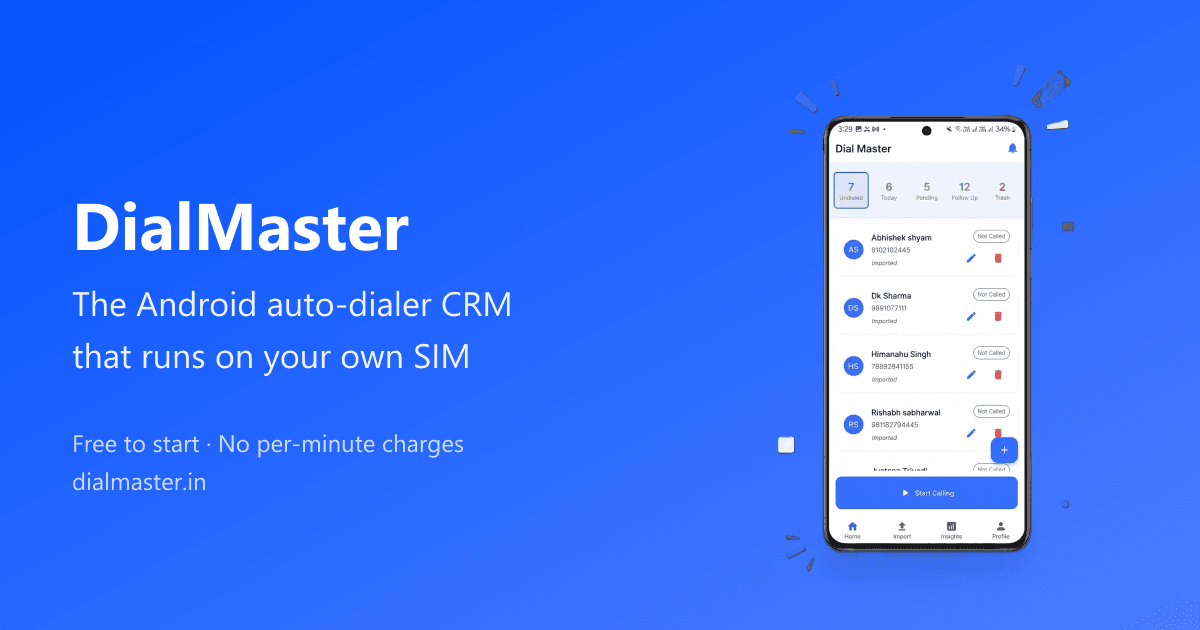
Why DialMaster
Built for the way you actually sell
STIR/SHAKEN Level A automatic
Calls placed through your Verizon/T-Mobile/AT&T cellular SIM receive Level A attestation by default — the highest carrier-level trust.
Consent metadata on every lead
Each lead carries its consent source, date, topic and source URL — so when a complaint arrives months later you can actually produce the record.
Instant DNC suppression
One-tap 'Mark DNC' permanently removes the number from all future queues with timestamped audit log.
No shared VOIP DID risk
Your real cellular number = your reputation. No risk of inheriting carrier-side spam scoring from previous DID tenants.
Free Forever plan
The Starter plan is free forever, so putting a compliant process in place does not require a purchase order.
Works for solar, mortgage, real estate, insurance
Specifically built for the outside-sales verticals most affected by the FCC's 2024 enhanced restrictions.
TCPA Risk: DialMaster vs Desktop VOIP Dialers
| Feature | DialMaster | PhoneBurner / Mojo / Kixie / Aircall |
|---|---|---|
| STIR/SHAKEN attestation | Level A (real SIM) | Level B typical (VOIP) |
| Number reputation risk | Your number, your reputation | Shared DID pools |
| 1:1 consent storage | Per-lead metadata | Platform-aggregated |
| Instant DNC revocation | One-tap, global suppression | Manual list management |
| Pre-call DNC check | Imported-list flag | Add-on service |
| Cost per agent / month | $0 (Starter plan) | $85 – $214 |
Core TCPA Rules (60-Second Summary)
- Prior express written consent before any autodialed or pre-recorded marketing call to a mobile number — naming your company, not a list vendor's partner network.
- National DNC scrub within 31 days of each campaign. State DNC registries must be checked separately for 12 states.
- Accurate caller ID. STIR/SHAKEN attestation governs how carriers vouch for the number you present; poor attestation is what gets calls labelled “Spam Likely”.
- Instant revocation when a contact requests removal.
- AI-voice = automated. AI calls require the same opt-in consent as old robocalls.
Penalty Schedule (Per Call, Not Per Campaign)
- Negligent violation: $500 per call
- Willful violation: $1,500 per call
- Class action exposure: $500–$1,500 × class size, often resulting in $5M+ judgments
- No per-campaign or per-year cap — a single non-compliant campaign can generate seven-figure liability
Does the TCPA apply if I'm not using an autodialer?
Yes — and this is the most expensive misconception in outbound sales.
The TCPA has several independent parts. The autodialer and pre-recorded call provisions turn on the technology you use, and the Supreme Court's decision in Facebook v. Duguid (2021) narrowed what counts as an autodialer considerably. Plenty of modern dialling software falls outside that definition.
But the Do Not Call provisions do not care what technology you used. Calling a number on the National DNC Registry for marketing purposes is actionable whether an agent dialled it by hand, tapped it from a list, or a machine placed it. The same is true of the internal do-not-call list requirement and the identification requirements in the FTC's Telemarketing Sales Rule.
So “we dial manually” is not a compliance strategy. It removes one category of exposure and leaves the rest untouched.
Consent rules are actively contested — check before you rely on them
This area moves faster than most compliance content acknowledges, and pages that state a rule confidently are often quoting something a court has since changed.
The FCC's so-called one-to-one consent rule — which would have required consent naming a single identified seller, closing the lead-generator loophole — was due to take effect in January 2025 and was vacated by the Eleventh Circuit in Insurance Marketing Coalition v. FCC before it did. Content still describing it as current law is out of date.
What has not changed is the underlying standard: for autodialed or pre-recorded marketing calls to a mobile number you need prior express written consent, and you need to be able to produce it. Buying a list whose consent was given to a lead aggregator's unnamed “marketing partners” has always been weak ground, regardless of the vacatur.
Several states also impose stricter requirements than federal law, including their own registries and calling-hour limits. Federal compliance is a floor, not a ceiling.
Confirm the current status of FCC consent rulemaking and any applicable state statutes before relying on this section.
Why VOIP Dialers Increase TCPA Risk Structurally
VOIP DIDs (used by PhoneBurner, Kixie, Mojo, Aircall, CallHippo) carry three compliance risks that real-SIM mobile dialers don't:
- Level B attestation. Carriers can't verify the actual caller, so calls get downgraded — increasingly flagged "Spam Likely."
- Number recycling. Pooled DIDs carry reputation from previous tenants.
- Muddied consent chain. Plaintiff lawyers exploit the platform's intermediation in court.
Frequently Asked Questions
Is the TCPA applicable without an autodialer?
Yes. The autodialer provisions turn on the technology you use, and the Supreme Court narrowed that definition in Facebook v. Duguid. The Do Not Call provisions do not turn on technology at all — calling a number on the National DNC Registry for marketing purposes is actionable whether a person dialled it by hand or a machine placed it. Dialling manually removes one category of risk and leaves the rest.
What makes a dialer TCPA compliant?
No dialer is compliant on its own — compliance is a property of your process. What software can do is make the right behaviour the default: scrub against the National DNC Registry, store per-lead consent with its source and timestamp, suppress a revoked number everywhere immediately, enforce permitted calling hours, and present accurate caller ID. A tool that cannot produce your consent record on demand is the problem.
What is the TCPA penalty per call?
Statutory damages are $500 per violation, rising to $1,500 per violation where the violation is wilful or knowing. There is no per-campaign or annual cap, so damages scale with the number of calls. That per-call structure is what makes class actions the primary financial risk rather than regulator action.
Is the FCC one-to-one consent rule in force?
The FCC rule requiring consent naming a single identified seller was due to take effect in January 2025 and was vacated by the Eleventh Circuit in Insurance Marketing Coalition v. FCC before it took effect. The underlying requirement for prior express written consent for autodialed and pre-recorded marketing calls to mobile numbers is unchanged. Confirm the current rulemaking status before relying on this.
Do state DNC registries matter if I scrub the national list?
Yes. Several states maintain their own registries and impose stricter rules than federal law, including narrower calling windows and additional disclosure requirements. Federal compliance is a floor. If you call into multiple states, your scrubbing process needs to cover each one you operate in.
Does DialMaster work with US carriers?
Yes. DialMaster works with any US Android cellular SIM including Verizon, T-Mobile, AT&T and the major MVNOs. Because calls originate from a real SIM rather than a pooled virtual number, the caller ID you present is a number registered to you, which is what carrier attestation is designed to verify.
Keep exploring
Explore the full toolkit
Download DialMaster — Free Forever
Uncapped dialing on the free plan. No credit card. No trial expiry.