UK Cold Calling Laws in 2026: PECR, GDPR, TPS and What They Actually Require
Direct answer: cold calling businesses in the UK is legal, but calling any number registered with the TPS or CTPS without prior consent is not. Screen against both registers before you dial, identify yourself on every call, present a valid caller ID, and honour opt-outs immediately. Live human calls are governed more lightly than pre-recorded or automated voice calls, which need explicit consent.
Last reviewed:
This page is general information about UK marketing and data-protection law, not legal advice. PECR and UK GDPR apply differently depending on whether you are calling individuals or corporate subscribers, and on what the person consented to. Check the ICO guidance linked below and take professional advice before relying on any of it.
Primary sources: ICO — Direct marketing and PECR · Telephone Preference Service (TPS) · Ofcom
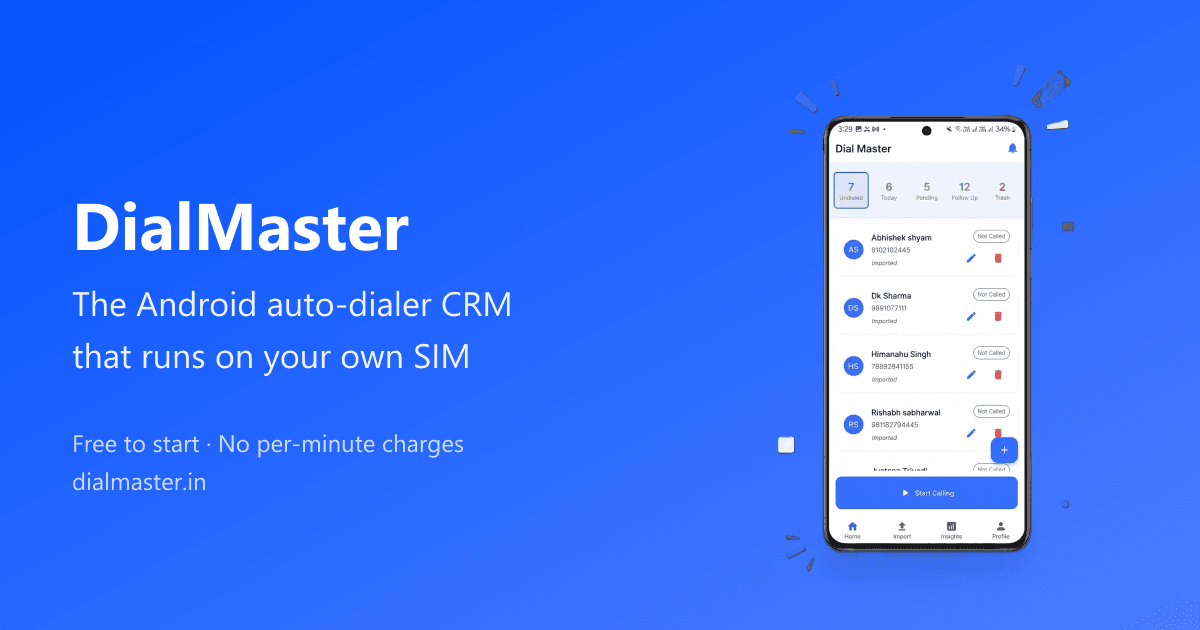
Why DialMaster
Built for the way you actually sell
Clean CLI presentation
Real UK cellular SIM = automatic Calling Line Identification per Ofcom requirements. No VOIP CLI gaps.
Direct consent chain
You're the named caller, not an intermediated platform. Simpler ICO defence.
On-device TPS markers
Import your TPS-scrubbed list with status tags. App respects suppression app-wide.
Forced disposition logging
Every call tagged with outcome, creating defensible audit records.
Zero Data Retention
Call data stays on the rep's device — DPDPA / UK GDPR data-minimisation aligned.
Free Forever plan
The Starter plan is free forever, so a compliant calling process does not need a purchase order.
UK Compliance: DialMaster vs VOIP Dialers
| Feature | DialMaster | Aircall / Dialpad / CallHippo UK |
|---|---|---|
| CLI compliance (Ofcom) | Real SIM automatic | VOIP CLI gaps common |
| Consent chain | Direct, your number | Platform-intermediated |
| Number recycling risk | None (your SIM) | Pooled DID issues |
| TPS marker storage | On-device tags | External management |
| Cost per user / month | £0 (Starter plan) | £25 – £140+ |
4 Core UK Rules in 60 Seconds
- TPS + CTPS screening before any marketing call.
- Explicit consent for pre-recorded and AI-voice calls (live human calls have lighter rules).
- Clear identification + opt-out on every call.
- Auditable consent + suppression records for ICO investigations.
TPS and CTPS: two registers, two different rules
The Telephone Preference Service covers individuals, including sole traders and unincorporated partnerships in most cases. The Corporate TPS covers registered companies, LLPs and public bodies. They are separate registers and screening one does not cover the other.
The practical rule is that you must not make unsolicited marketing calls to a number on either register unless that specific person or organisation has told you they are happy to be called. Someone else's consent does not transfer. A list vendor telling you the data is “TPS-screened and opted in” is a claim about their relationship, not yours.
Screening is not a one-off. Registrations are added continuously, so a list scrubbed three months ago is not a scrubbed list today. Build re-screening into the process rather than treating it as an import-time step.
Live agents, recorded messages and AI voice are treated differently
This is the distinction that decides how much consent you need.
A live human agent making a marketing call is governed by the TPS/CTPS regime described above — screen the register, respect objections, identify yourself.
Automated calls that play a recorded message require something stricter: specific prior consent from that person to receive automated marketing calls. Screening against TPS is not sufficient, and there is no soft opt-in shortcut here.
AI voice agents are the live question in 2026. The ICO's direct-marketing guidance treats a call where a machine, not a person, delivers the message as an automated call. If your AI agent conducts the conversation autonomously, plan on needing explicit prior consent rather than assuming it inherits the lighter live-agent rules. If you are deploying AI voice for outbound in the UK, this is the point to take advice rather than infer.
Caller ID and "local presence" dialling
You must present a valid, dialable caller ID on marketing calls. Withholding the number, or presenting one that cannot be called back, is a direct breach and one Ofcom has pursued.
That has consequences for the “local presence” feature sold by several US dialling platforms, which shows the recipient a number matching their area code to lift answer rates. In the UK the number you present must be genuinely yours and genuinely reachable. Rotating through a pool of local-looking numbers that do not connect back to you is not a grey area — it is the thing the CLI rules exist to stop.
Dialling from a real SIM sidesteps this entirely: the number you present is a number you hold, and it rings when someone calls it back. That is not a compliance feature so much as a consequence of not putting a virtual number in the middle.
What a breach costs
PECR enforcement historically sat under a separate, much lower cap than GDPR. The Data (Use and Access) Act 2025 changed that, bringing PECR penalties into line with UK GDPR levels — meaning the ceiling is now expressed as a percentage of global turnover rather than a fixed low maximum.
In practice the ICO's published enforcement against nuisance-call operators has typically been well below any ceiling, and has often been accompanied by enforcement notices requiring changes to practice. For most businesses the realistic risk is an enforcement notice, reputational damage and the operational cost of rebuilding a compliant process — not a headline fine.
Verify the current penalty ceilings and the commencement position of the Data (Use and Access) Act against ICO guidance before relying on specific figures.
Frequently Asked Questions
Is cold calling legal in the UK?
Yes, business-to-business and business-to-consumer cold calling is legal in the UK, but you must not call any number registered with the TPS or CTPS unless that person or organisation has specifically consented to hear from you. Live agent calls follow that regime. Pre-recorded and automated voice calls need explicit prior consent on top.
What is the difference between TPS and CTPS?
The TPS covers individuals, including most sole traders. The CTPS covers registered companies, LLPs and public bodies. They are separate registers with separate screening obligations, so checking one does not cover you for the other. Both need re-screening regularly because new registrations are added continuously.
Are AI cold calling agents legal in the UK?
The ICO treats a call where a machine rather than a person delivers the message as an automated call under PECR, which requires specific prior consent to receive automated marketing calls. TPS screening alone is not enough. If you are deploying autonomous AI voice agents for UK outbound, take professional advice rather than assuming live-agent rules apply.
Is local presence dialling legal in the UK?
Marketing calls must present a valid caller ID that the recipient can call back. Rotating through local-looking numbers that do not connect back to you breaches those rules. If you use a local-presence feature, the numbers it presents must genuinely belong to you and must be answerable.
Do I need consent to call a business number?
For corporate subscribers you must still screen against the CTPS, and the organisation must not have objected to your calls. Corporate subscribers have fewer protections than individuals under PECR, but 'B2B' is not a blanket exemption — and sole traders are generally treated as individuals, not businesses.
Does DialMaster work in the UK?
Yes. DialMaster works with any UK cellular SIM including EE, Vodafone, O2, Three, Tesco Mobile and Giffgaff. Because it dials from your own SIM, the caller ID you present is a real number that rings when someone calls it back. The Starter plan is free forever.
Keep exploring
Explore the full toolkit
Download DialMaster — Free Forever
Uncapped dialing on the free plan. No credit card. No trial expiry.