TRAI Calling Rules in India (2026): Hours, DND, Consent & Penalties
Direct answer: TRAI permits commercial calls only between 9 AM and 9 PM IST, and you may not make promotional calls to any number registered on the DND list. Those two rules catch most businesses. The ones that catch the rest are DLT registration and being able to prove, on demand, that a person consented to hear from you.
Last reviewed:
This page is general information about Indian telecom regulation, not legal advice. Rules change, and how they apply depends on your business, your telecom operator agreement, and the kind of calls you make. Check the primary sources below and take professional advice before relying on any of it.
Primary sources: TRAI (Telecom Regulatory Authority of India) · Department of Telecommunications, Government of India
Why DialMaster
Built for the way you actually sell
Calls stop automatically at 9 PM
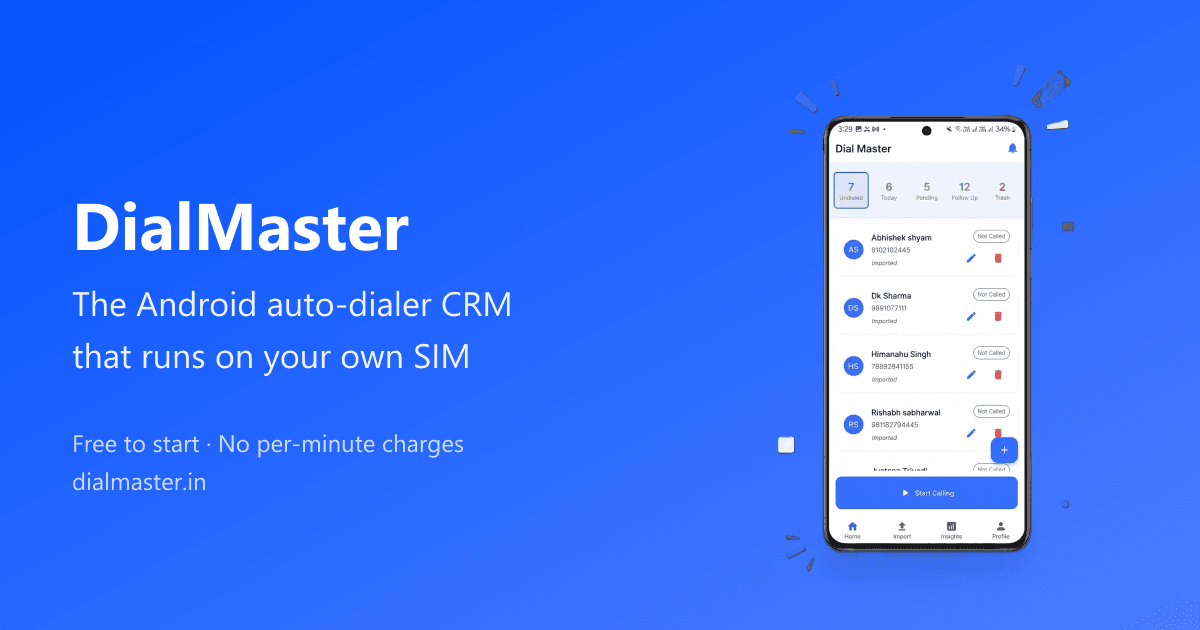
The dialer hard-stops at 9 PM IST and will not resume until 9 AM. You are not relying on an agent watching the clock at the end of a long shift.
One-tap DND marking
Mark a contact and they are removed from every future queue permanently, with a timestamp you can point to later.
You are the registered sender
Calls originate from your own SIM, so the number making the call is a number you already hold in your own name rather than a shared virtual DID.
Every call gets a disposition
The app requires an outcome before moving on, which is what turns a call list into an audit trail worth having.
Consent evidence stays with you
Lead source, timestamp and outcome are stored on your device, not on a vendor's server you would have to request an export from.
Free to start
The Starter plan is free forever, so putting a compliant process in place does not require a purchase order.
Compliance burden: SIM-native dialing vs cloud telephony
| Feature | DialMaster | Cloud telephony (VoIP) |
|---|---|---|
| 9 AM – 9 PM enforcement | Built-in hard stop | Manual configuration |
| Who is the calling party | You, on your own number | Shared or pooled virtual number |
| DND handling | One-tap, app-wide, timestamped | Manual list management |
| Truecaller spam-flag exposure | Low — a real personal SIM | High — virtual DIDs are flagged often |
| Where consent evidence lives | On your device | Vendor cloud, export on request |
| Cost of running compliantly | $0 software | Per-seat plus per-minute |
The rules, in the order they usually bite
India's commercial calling rules sit in TRAI's Telecom Commercial Communications Customer Preference Regulations — the TCCCPR. It is worth reading the source, but the working summary is short.
- Call only between 9 AM and 9 PM IST. This applies to promotional and commercial calls. A call at 8:45 PM is fine. A call at 9:10 PM is not, and “the agent lost track of time” is not a defence.
- Do not make promotional calls to DND-registered numbers. Registration happens through the National Customer Preference Register. Scrubbing your list against it is your job, not the recipient's.
- Register on a DLT platform. Your entity, your sender headers and your message templates all have to be registered before you send commercial SMS. This is where most businesses discover they are non-compliant.
- Be able to prove consent. Not “we bought a list and they seemed interested” — an actual record of who agreed, when, and through what form.
- Tell your operator what you are doing. Bulk commercial calling is expected to be declared to your access provider rather than run quietly off a consumer connection.
What counts as a "promotional" call — and what doesn't
This is the distinction people get wrong most often, and it decides whether the DND rules apply to you at all.
Promotional means you are trying to sell something to someone who has not asked. A cold call about a new insurance product is promotional. So is calling a purchased list of “interested” property enquirers who never actually gave you their number.
Transactional or service calls relate to something the customer already has with you — a delivery update, an OTP, a payment reminder on an existing loan, a service appointment. These are treated differently, and the DND preference categories generally do not block them.
The trap is the middle ground. Calling an existing customer to sell them a second product is not a service call just because they are already a customer. If the purpose of the call is to sell, treat it as promotional and behave accordingly. Regulators look at the purpose of the call, not the label you applied to it internally.
DND and the preference categories
Indian subscribers can register a full block on commercial communication, or block specific categories while allowing others — banking and insurance, real estate, education, health, consumer goods, tourism and so on.
Two practical consequences. First, “this number is on DND” is not always a total block; someone may have blocked real estate while remaining open to banking. Second, and more importantly for your process, the responsibility to check sits with you before you dial. Scrubbing a list once at import and never again is not enough if that list gets called for months, because registrations change.
If someone tells you on a call to stop contacting them, that is an opt-out regardless of what any register says. Record it immediately and make sure it propagates to every list you hold, not just the one you happened to be dialling.
DLT registration: entity, header, template
Distributed Ledger Technology registration is the piece most small businesses skip, usually because they think it only applies to SMS. It is a three-part process: register the entity (your business), register the headers you will send from, and register each template you will use.
Headers carry a suffix denoting the message type — promotional, service, transactional or government. Using a promotional header for what is really a transactional message, or the reverse, is a compliance failure even when the content itself is harmless.
If your outbound motion is calls followed by a WhatsApp or SMS follow-up — which describes most Indian sales teams — the call side and the message side are governed differently. Getting the calling hours right does not make your follow-up messages compliant.
What consent actually has to look like
Consent is only useful if you can produce it later. In practice that means capturing, at the moment someone opts in: the timestamp, the source (which form, which campaign, which page), and what exactly they agreed to receive.
A pre-ticked checkbox is not consent. A phone number typed into a competition entry is not consent to be sold insurance. A list bought from a broker comes with no consent you can rely on, whatever the broker claims — their consent, if it existed at all, was for them.
Store the evidence somewhere you can actually retrieve it under time pressure. A complaint tends to arrive months after the call, and “we know we had consent” without a record is the same as no consent.
What happens when you get it wrong
The TCCCPR sets out graded financial disincentives that escalate with repeat violations — commonly cited as ₹2 lakh, then ₹5 lakh, then ₹10 lakh for subsequent breaches, alongside the possibility of numbers being suspended or disconnected and the sender being blacklisted.
One nuance worth understanding, because it is widely misreported: these disincentives are levied by the regulator on access providers — the telecom operators. What reaches you is contractual. Your operator, having been penalised, enforces it against you through the agreement you signed with them, which is why disconnection and blacklisting are the sharp end for most businesses rather than a direct regulatory fine.
The commercial damage usually arrives before any of that. Numbers that generate complaints get flagged by call-screening apps, and a flagged number stops connecting long before a regulator gets involved.
Confirm the current figures and the direction of liability against the TCCCPR text before relying on the amounts above.
Why virtual numbers make all of this harder
Cloud telephony platforms route your calls through virtual numbers that the platform owns. That creates three compliance frictions that have nothing to do with the quality of the software.
The calling party is a pooled or shared number rather than one registered to you, which complicates the paper trail. Consent evidence lives on the vendor's infrastructure, so producing it means raising a request with a third party. And virtual DIDs attract spam reports at a far higher rate than personal SIMs, which — separately from any regulation — is what actually destroys your connect rate.
Dialling from a SIM you already own inverts all three. You are the calling party, the record is yours, and the recipient sees a normal Indian mobile number. That is the architectural argument for a SIM-native dialer over cloud telephony for Indian outbound, and it is why we built DialMaster the way we did.
A checklist you can actually run
- Declare bulk commercial calling to your access provider.
- Complete DLT entity, header and template registration.
- Configure a hard 9 PM stop in your dialer — do not rely on agent discipline.
- Scrub every list against DND at import, and re-scrub long-running lists.
- Put a real consent checkbox on every lead form, unticked by default.
- Capture timestamp, source URL and campaign against every consent record.
- Use the correct header suffix for each message type.
- Give every promotional message a working opt-out path.
- Honour verbal opt-outs immediately and across all lists.
- Sample your own calls quarterly and train agents on the two rules that matter most: the window, and DND.
Frequently Asked Questions
What are the TRAI guidelines for outbound calling timings?
TRAI permits commercial and promotional calls only between 9 AM and 9 PM Indian Standard Time. Calls placed outside that window breach the TCCCPR regardless of whether the recipient objects. Transactional and service calls relating to an existing relationship are treated differently.
Is using an auto dialer legal in India?
Yes. Auto dialers are legal in India provided you follow the TCCCPR: call only between 9 AM and 9 PM, do not make promotional calls to DND-registered numbers, complete DLT registration for commercial messaging, keep provable consent, and declare bulk commercial calling to your telecom operator.
What is the penalty for breaching TRAI calling rules?
The TCCCPR sets graded financial disincentives that escalate with repeat breaches, commonly cited as ₹2 lakh, ₹5 lakh and ₹10 lakh, together with number suspension, disconnection and blacklisting. These are levied on telecom access providers, who then enforce them against senders through their commercial agreements.
Does DND apply to every call I make?
No. DND applies to promotional calls. Transactional and service calls about something the customer already has with you — a delivery, an OTP, a payment reminder on an existing account — are treated separately. Calling an existing customer to sell them an additional product still counts as promotional.
Do I need DLT registration if I only make calls and never send SMS?
DLT registration governs commercial messaging headers and templates. If your process is calls followed by SMS or WhatsApp follow-ups, which is typical for Indian sales teams, the messaging side needs DLT registration even though the calling side does not. Getting your calling hours right does not make your follow-ups compliant.
How does DialMaster help with TRAI compliance?
DialMaster stops dialling at 9 PM IST automatically, supports one-tap permanent DND marking, requires a disposition on every call so you build an audit trail, and stores consent and outcome data on your own device. It dials through your own SIM, so you are the registered calling party rather than a shared virtual number.
Keep exploring
Explore the full toolkit
Download DialMaster — Free Forever
Uncapped dialing on the free plan. No credit card. No trial expiry.