Field Sales Mobile-Only Playbook (USA, UK, AU 2026)

How outside reps run outbound entirely from a phone: the stack, six working principles, a two-week trial that gives a real answer, and where it does not fit.
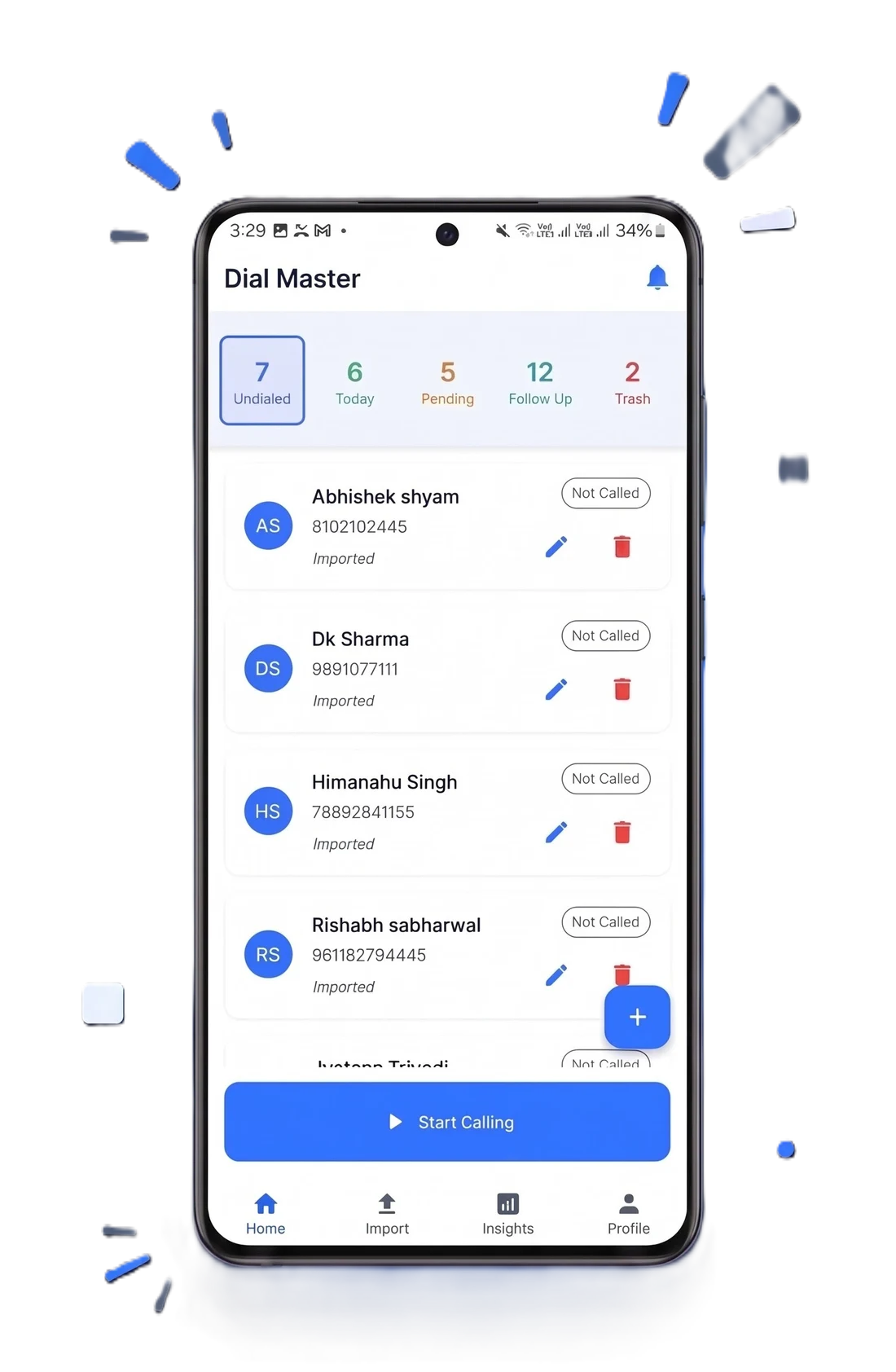
Direct answer: Mobile-only field sales means running the whole outbound workflow from a phone: leads arrive by webhook, calls go out over your own SIM, outcomes are logged at hang-up, follow-ups fire from templates, and no laptop is opened. It is not right for every role — but for reps who spend the day driving between appointments, the laptop was never the productive part.
This is a playbook rather than a pitch. It sets out what the stack looks like, which principles make it work, how to run a two-week trial that produces a real answer, and — importantly — the situations where mobile-only is the wrong call.
A note on numbers: you will find articles claiming specific productivity gains from this switch. We are not going to give you one, because we have no data that would make it honest. What this page gives you instead is a method for measuring it on your own team in two weeks.
Why the desktop stopped being the source of truth
For a decade "mobile-first" meant a desktop product with a phone companion. The desktop held the truth; the phone was for emergencies. Three things eroded that for outside reps specifically.
- Cellular voice got cheap relative to metered VoIP. When a rep's own plan carries unlimited domestic calls, routing sales calls through a separate metered network stops making economic sense for low-to-moderate volume.
- Caller authentication started to matter. Carrier signing and handset-level spam labelling treat a number issued to a known subscriber differently from an unfamiliar routed DID.
- The last laptop-only tasks went phone-native. Document signing, scheduling, storage and drafting are all genuinely usable on a phone now. That was not true in 2020.
None of that makes the desktop obsolete. It makes the desktop optional for one specific role — the rep who is not at a desk.
The stack, layer by layer
| Job | Desktop stack | Phone-only equivalent | Trade-off |
|---|---|---|---|
| Dialing | Desktop power dialer over VoIP | Mobile dialer over your SIM | Lose multi-line; gain portability and cost |
| Pipeline | Full CRM | Dialer's built-in pipeline | Lose reporting depth; gain outcome capture that actually happens |
| Lead intake | CSV export and import | Webhook straight to the queue | Strictly better; removes the manual step |
| Follow-up | Sequencing platform | Messaging templates, one tap | Lose cadence automation; gain same-day sends |
| Scheduling | Calendar plus a booking tool | The same tools, mobile apps | No meaningful loss |
| Documents | Desktop signing and storage | Mobile signing and storage | No meaningful loss for standard agreements |
| Analysis | BI dashboards | Not on a phone | A genuine gap — see the limits below |
Six principles that make it work
- One source of truth, and it is the phone. The failure mode is a rep maintaining two systems and trusting neither. Pick one and let the other be a downstream report.
- Typing is the enemy. Every interaction should be a tap: dispositions as buttons, follow-ups as templates, scripts pre-loaded. A workflow that needs a keyboard will not survive a car park.
- Cellular is the call infrastructure. Your existing plan carries the calls, which removes both the per-minute line and the dependence on finding Wi-Fi.
- Cloud-attached, not cloud-dependent. Calls and notes must work with no signal and sync later. This single property decides whether field reps adopt a tool.
- AI for wording, not for workflow. Use it to draft scripts and messages. Keep the process itself simple and tactile — see what to automate first.
- Time-box the day. Dial blocks, follow-up blocks, a ten-minute close. Structure is what makes a phone-based day productive rather than reactive.
The adoption test
Count the taps required to log one call outcome, then multiply by the rep's daily call volume. That number predicts adoption better than any feature comparison — and it is the number vendors never put on a pricing page.
A structured day
- Before you drive: triage overnight leads, queue the hot ones. Five minutes.
- First block: work the queue from the driveway or a car park before the first appointment.
- During appointments: phone in pocket. Capture anything that needs capturing on the spot rather than reconstructing it later.
- The gaps: fifteen minutes parked is a real dial block if the tool opens instantly.
- Same-day follow-up: anything promised in a meeting goes out that evening, not on Thursday.
- Ten-minute close: callbacks dated, tomorrow's queue built.
Run a two-week trial that gives a real answer
Most switches fail because they are evaluated on feeling. This produces a number instead.
- Days 1–2 — record the baseline. Current calls per day, connect rate, meetings booked, and current monthly tooling cost. Without this the trial proves nothing.
- Day 3 — set up in parallel. Import leads, connect one lead source, build two message templates. Change nothing else.
- Days 4–8 — run both, same segment, same hours. Like-for-like or the comparison is worthless.
- Day 9 — compare the four baseline numbers. Not impressions. Numbers.
- Days 10–13 — run mobile-only. If the numbers held, remove the old tool from the loop and see whether anything breaks.
- Day 14 — decide, and write down why. Including the decision to stay put, which is a legitimate outcome.
Where mobile-only is the wrong call
Being specific here is what makes the rest of the playbook trustworthy.
- Inside sales at volume. Desk-based reps running parallel dialing are better served by the desktop tools built for it.
- Contact centres with inbound queues. IVR, routing and workforce management are a different product category.
- Mandatory call recording. Several regulated sectors require it on every line.
- Analysis-heavy roles. Multi-tab dashboards and pipeline modelling need a large screen, and pretending otherwise wastes people's time.
- Organisations whose system of record cannot be fed from a phone. If outcomes cannot reach the CRM your company reports on, you have created a data island.
Compliance travels with you
A mobile-only stack does not change your obligations — and because the same rep may call across markets, it is worth knowing which regime applies. In the USA, consent and caller authentication sit with the FCC and abandoned-call limits with the FTC. In the UK, direct marketing calls fall under PECR, with guidance from the ICO. In Australia, calling windows are fixed by the Telemarketing Industry Standard.
Our summaries: TCPA, UK cold calling, TRAI. All are general information rather than legal advice.
The short version
Mobile-only is not a philosophy, it is a fit question. If your reps are in cars, the laptop is overhead and removing it removes real friction. If your reps are at desks, the desktop tools are better and this playbook is not for you.
Run the two weeks, keep the four numbers, and let those decide.
The four numbers that decide it
Everything in this playbook reduces to whether four measurements improve. Anything else is preference.
| Metric | Why it matters | How to read a change |
|---|---|---|
| Calls placed per day | Measures friction removed | Should rise if dead time was the constraint |
| Connect rate | Measures list, timing and number reputation | Compare same hours only, or the change is noise |
| Meetings booked | The only outcome that pays | Flat here means throughput was not your problem |
| Cost per rep per month | Measures what you stopped paying | Include the mobile plans; excluding them flatters the result |
The third row is the important one. A stack that raises calls per day but not meetings booked has told you something valuable — that your constraint was the conversation or the list, and no tooling change will fix it.
Failure modes, and how each shows up
- The shadow spreadsheet. A rep keeps their real list somewhere else. Shows up as pipeline data that does not match reported activity. Fix the tap count, not the rep.
- Outcomes logged in batches. Twenty dispositions entered at 6pm are twenty guesses. Shows up as suspiciously uniform outcomes late in the day.
- Follow-ups without dates. "Call them back soon" is not a commitment the system can surface. Shows up as leads aging quietly past three weeks.
- Silent lead-intake failure. A webhook stops and nobody notices for nine days. Shows up as a quiet week that gets blamed on the market. Reconcile weekly against platform-reported counts.
- Two systems, neither trusted. The most expensive failure, because it doubles the admin the switch was meant to remove.
Pro tip: the tap count to log one outcome is the most predictive number in this whole playbook. Count it on any tool you evaluate, multiply by daily call volume, and you will know whether reps will adopt it before you buy a single seat.
Adapting it by role
- Real estate. Recency dominates — portal enquiries decay fast, so the intake-to-dial gap is the metric that matters most. See the real estate guide.
- Insurance. Long cycles and repeat contact make the callback discipline and the note quality the binding constraints, not raw dial volume.
- Solar and mortgage. Consent provenance has to travel with the lead; the compliance record is part of the workflow rather than a separate system.
- B2B field sales. Fewer, larger accounts mean the pipeline view matters more than throughput, and a phone-only stack is a weaker fit above a certain deal complexity.
The principles hold across all four. What changes is which of the four numbers you are optimising.
What to do when the trial says no
A two-week trial that ends in "stay put" is a successful trial, and it usually points at something more valuable than the tooling question you started with.
- Calls rose but meetings did not. Throughput was never your constraint. The list or the offer is, and no dialer fixes either. Look at segmentation before you look at software again.
- Connect rate did not move. Either your numbers were fine already, or you compared different hours. Re-check the second before concluding the first.
- Reps reverted to the old tool by day four. That is a tap-count problem, not a preference. Count the taps to log one outcome in each system and you will usually find the answer immediately.
- Everything improved except reporting. This is the most common real outcome. Keep the phone as the working surface and solve the reporting path rather than abandoning the gain.
The trial is worth running for what it tells you about the constraint, even when the answer is that your software was never the problem. Most teams discover their binding constraint is one they had never separated out — see diagnosing connect rate.
Rolling it beyond the first rep
A successful single-rep trial does not automatically scale, and the failures at team level are different from the failures at individual level.
- Agree the reporting path first. Before the second rep moves, settle how outcomes reach whatever the business reports on. This is the constraint that ends most rollouts.
- Standardise dispositions across the team. Two reps using the same code differently makes the aggregate meaningless — the individual trial never exposes this.
- Name an owner for the lead-intake plumbing. Webhooks fail silently, and at team scale nobody notices for a week because everyone assumes it is someone else's quiet period.
- Move in pairs, not all at once. Two reps at a time keeps a working comparison group and keeps the rollback cheap.
Related: solar and mortgage outside sales, building a remote sales team, desktop dialer comparison, features, and the free plan.
Stop manually dialing. Start closing.
Install DialMaster on your Android device and dial your first list in under five minutes. Free forever, no credit card, no VoIP bill — and your leads never leave your phone.