Omnichannel Lead Ingestion: Stop Spreadsheet Sales
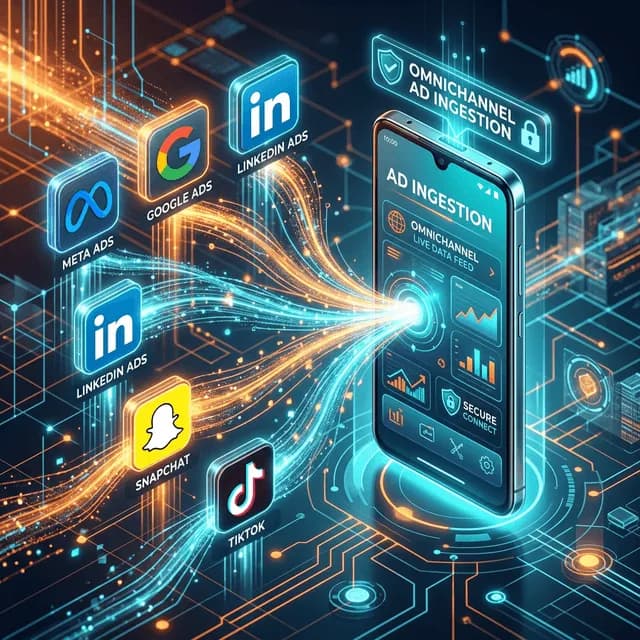
10+ ad platforms connected instantly. Stop downloading messy spreadsheets — learn how modern sales teams ingest leads with zero delay.
TL;DR
Direct answer: Omnichannel lead ingestion means every source — Meta and Google Lead Ads, LinkedIn, your website form, marketplace portals — lands in one queue automatically, with no CSV download in the middle. The point is response time: a lead worked within minutes converts far better than the same lead worked hours later, and manual exports are where those hours go.
In modern outbound sales, your conversion rate is inversely proportional to your response time. If you generate a lead from a Facebook Ad and your agent calls them 4 hours later, the intent has evaporated. Your competitor has already spoken to them. MIT's Lead Response Management study quantified this: leads contacted within 5 minutes are 21x more likely to enter your sales pipeline than leads contacted after 30 minutes.
Yet the vast majority of sales teams — from 3-person startups to 50-agent call centers — still manage lead distribution through downloaded CSV files, email forwards, and shared Google Sheets. This "Messy Spreadsheet" workflow introduces fatal delays, data errors, and lost leads. Omnichannel lead ingestion eliminates all of it.
The "Messy Spreadsheet" Problem
Here's the typical workflow we see in 80% of Indian SMBs and many global sales teams:
- Marketing manager logs into Facebook Ads Manager at 10 AM and downloads yesterday's leads as a CSV file.
- Opens Google Ads, downloads another CSV. Then LinkedIn Lead Gen. Then Indiamart. Each platform has different column formats.
- Merges all CSVs into a master spreadsheet, removing duplicates manually.
- Emails the spreadsheet to the calling floor manager.
- Manager distributes rows to agents via WhatsApp groups or printed sheets.
- Agents manually type phone numbers into their dialers.
By the time Step 6 completes, 12-24 hours have passed since the lead originally submitted their inquiry. The lead has forgotten they filled out a form, spoken to 3 competitors, and moved on. Your ₹500 per-lead ad spend is wasted.
What Is Omnichannel Lead Ingestion?
Omnichannel Ingestion means centralizing all your lead sources — paid ads, organic forms, portals, purchased databases — directly into your execution environment (your dialer + CRM) with zero human intermediation. The lead arrives on the agent's phone within seconds of submission, ready to be auto-dialed immediately.
Supported Platforms & How They Connect
| Platform | Connection Method | Delivery Speed |
|---|---|---|
| Meta (Facebook/Instagram) Lead Ads | Sign in from the app | Seconds |
| Google Ads lead forms | Webhook URL on the lead form | Seconds |
| LinkedIn Lead Gen Forms | Sign in from the app (Zapier or Make while LinkedIn enables delivery) | Seconds |
| TikTok Lead Generation | Webhook | Seconds |
| Indiamart / TradeIndia / JustDial | CSV Export + Upload | Minutes |
| 99acres / MagicBricks / Housing.com | CSV Export + Upload | Minutes |
| Website Forms (custom) | Custom Webhook POST | Seconds |
How Zero-Delay Routing Works
- The Trigger: A prospect submits a form on your Facebook Ad at 2:47 PM.
- The Ingestion: Meta tells DialMaster a lead exists, and DialMaster fetches the name, phone number and email through the connection you signed in with.
- The Routing: DialMaster checks the lead against what already arrived, so the same person is not queued twice, and pushes a notification to your phone.
- The Execution: Within seconds of submission your phone shows "A new lead just came in from Facebook. Tap to import and call." One tap puts the lead in your call queue, and you call the prospect while the form is still fresh in their mind.
The Cost of Connector Tools vs Direct Connections
Many teams use third-party tools like Zapier, Make (formerly Integromat), or LeadsBridge to route leads from ad platforms to their CRM. These tools work, but each one is another subscription to pay for and another hop in the path:
- Connector tools: priced by the vendor, and still one more system between the ad platform and the person making the call.
- Direct connections (DialMaster): included on every plan. Meta and LinkedIn connect by signing in, and most other sources take your webhook URL directly, with nothing in between.
For a small business spending ₹50,000/month on Facebook Ads, paying for a separate connector just to move the leads to your CRM is overhead a direct connection removes. Keep Zapier or Make for the platforms that have no outbound webhook, such as Microsoft Advertising and Amazon Ads.
Handling Legacy and Offline Data
Not all leads come from digital ads. Purchased databases, trade show contacts, referral lists, and walk-in inquiries still need to enter your pipeline. DialMaster handles this through:
- CSV/Excel Upload: Upload contacts from any spreadsheet format directly on your Android phone, 100 new contacts per import.
- Raw Text Paste: Copy-paste unstructured data (names and phone numbers) directly into the app — it auto-parses and creates lead records.
- Manual Entry: Add individual leads with notes and tags for walk-in or referral contacts.
Conclusion: Speed Is the New Sales Skill
Why the delay between ad click and first call is the whole game
Lead response research has been consistent for well over a decade on one point: the drop-off between an immediate call and a call an hour later is not incremental, it is a cliff. The mechanism is not mysterious. Someone who filled a form thirty seconds ago is still thinking about your product. Someone who filled it four hours ago has moved on, spoken to two competitors, and forgotten which ad they clicked.
Every manual step between the form submission and the phone ringing is time spent on the wrong side of that cliff. The export, the email, the spreadsheet merge, the distribution to agents — each one is defensible on its own and collectively they are the reason the lead is cold.
The three ways leads reach a dialer, ranked by delay
- Webhook — seconds. The ad platform posts the lead the moment the form is submitted. The agent's phone has it before the prospect has closed the tab.
- Scheduled sync — minutes to hours. A connector polls on an interval. Better than manual, still bounded by the polling window.
- Manual export — hours to days. Someone remembers to download a CSV. This is where most teams still are, and it is why their speed-to-lead figures look the way they do.
The one measurement worth instrumenting
Not leads generated, not dials made. Median minutes between form submission and first dial attempt. It is the number that predicts conversion, and almost nobody tracks it — which is precisely why improving it is available to you.
Setting up direct ingestion without a connector subscription
Third-party automation tools are useful for complex multi-system workflows. For getting a lead from an ad platform to a dialer, they are an extra subscription and an extra point of failure in a path that only has two ends.
- Connect or copy. Meta and LinkedIn connect by signing in from the app. For everything else, copy your personal webhook URL.
- Paste the URL into the platform. Google Ads lead forms, TikTok, Snapchat and form tools such as Typeform or JotForm all accept it.
- Map the two fields that matter. Phone and name. Everything else can follow later; nothing else is needed to place a call.
- Send a test lead. Every platform has a testing tool. Use it before the campaign spends money, not after.
- Confirm it lands on the agent's phone, not a dashboard. A lead sitting in a web console nobody has open is the same as a lead in a spreadsheet.
Platform-by-platform detail is in importing ad-platform leads, and the full list of supported sources is on the integrations page.
What to do about the sources that will never have a webhook
Portal enquiries, trade-show lists, purchased data and referrals are not going to post to an endpoint. The answer is not to force them into one — it is to make the manual path fast enough that it stops mattering.
- Paste beats upload. Copying a block of numbers straight out of an email is faster than saving a CSV and finding it in a file picker.
- Import daily, not weekly. A batch you import every morning is never more than a day stale.
- Tag every batch by source. Without it you cannot tell which channel is worth the spend.
One Queue, Not Six Inboxes
The word "omnichannel" usually gets sold as breadth — more sources connected. The value is the opposite: it is consolidation, and the test is whether a rep looks in one place or six.
- One queue, ordered by age. If a rep has to decide which source to check next, the least-loved source silently stops being worked. Ordering by enquiry age removes the decision entirely.
- Source as an attribute, not a location. Where a lead came from should be a field you can report on, never a separate list to visit. The moment sources live in different places, the comparison you actually need — which source converts — becomes impossible.
- One dedupe rule, applied on arrival. Serious buyers enquire more than once, often across platforms. Deduplicating at the point of entry keeps the queue honest; doing it later means your speed-to-lead figures already lied.
The failure mode worth naming: teams that connect every source and skip consolidation end up slower than when they exported one CSV a day, because now nobody knows where the next call is coming from. Breadth without a single queue is not automation — it is more places to look.
Where this stops being enough
Direct ingestion solves speed. It does not solve routing logic — round-robin by territory, skill-based assignment, or lead scoring before distribution. If you need those, you need a routing layer, and this is the wrong tool on its own.
What it does solve is the case most teams actually have: a small number of ad sources, a handful of agents, and a delay measured in hours that should be measured in seconds. Related: improving connect rates and lead management.
Data fragmentation is the silent killer of advertising ROI. Every hour of delay between lead submission and first contact directly reduces your conversion rate. By adopting an Auto Dialer CRM with native omnichannel ingestion, you eliminate manual triage, empower your agents with instant lead delivery, and guarantee that every single lead is contacted at the absolute peak of their buying intent.
Stop manually dialing. Start closing.
Install DialMaster on your Android device and dial your first list in under five minutes. Free forever, no credit card, no VoIP bill — and your leads never leave your phone.