Free Reapit & Agentbox Alternative (Australia 2026)

Reapit, Rex and VaultRE compared honestly for independent Australian agents, plus the free mobile prospecting layer and the ACMA calling rules that govern it.
Direct answer: Reapit, Rex and VaultRE are agency-grade Australian real estate CRMs — listings, trust accounting, property management and portal integration in one system. None of them publishes per-seat pricing, so treat any figure you read online as unverified. For an independent agent whose actual daily problem is prospecting calls rather than agency administration, a free mobile dialer with a built-in pipeline covers that workflow without an agency licence, and sits alongside the agency CRM rather than replacing it.
On pricing: an earlier version of this page quoted per-seat figures for Reapit, Rex, VaultRE and others. None of those vendors publish prices, so the numbers could not be traced to a source and have been removed rather than refreshed. Request a written quote and compare it against what you actually use.
What Australian agency CRMs actually do
The category is frequently misdescribed as "CRM", which undersells it. An Australian agency platform is really four products bundled together, and only one of them is a CRM in the sales sense.
- Listings and portal distribution. Pushing to realestate.com.au and Domain, managing the listing lifecycle. This is the core.
- Trust accounting. A regulated function with state-by-state obligations. Not optional for an agency handling client money.
- Property and tenancy management. An entirely separate business line from sales.
- Contact and pipeline management. The part an individual agent touches daily — and the part most agents complain about.
That bundle is why the licence is expensive and why an individual agent rarely feels they are getting value from it: three quarters of what they are paying for belongs to the agency, not to them.
Where the friction actually is
The common pattern in Australian agencies is not that the CRM is bad. It is that the agency CRM lives on a desktop and the agent lives in a car. Agency platforms ship mobile companion apps, but a companion app is designed for looking things up, not for working a call list between inspections.
So agents improvise. They keep a call list in their phone's notes, or a spreadsheet, or their own head — and the outcomes of those calls never reach the agency system. That gap, not the licence fee, is the real cost.
The question worth asking
Is your problem the agency CRM, or is it that nothing captures what happened on the calls you made today? Those have different solutions, and only one of them involves changing your agency's software.
When the agency platform is clearly right
- You handle trust money. This is a regulated function; do not improvise it.
- You manage rentals. Property management is its own product and a dialer does not touch it.
- You need listings pushed to portals from one place. Portal distribution is the whole point of these platforms.
- You run multiple offices. Centralised reporting across franchises is exactly what they are built for.
- Compliance records must live in one auditable system. Fragmenting that is a bad trade at any price.
When a mobile dialer is the better tool
- You are an independent or buyer's agent running your own pipeline, where prospecting volume is the constraint.
- You work from the car, open homes and appraisals rather than a desk, and the laptop is what slows you down.
- You want the agency CRM to stay the system of record while your daily prospecting happens somewhere faster. This dual setup is common and works well.
- You are testing whether an outbound habit sticks before committing budget to it.
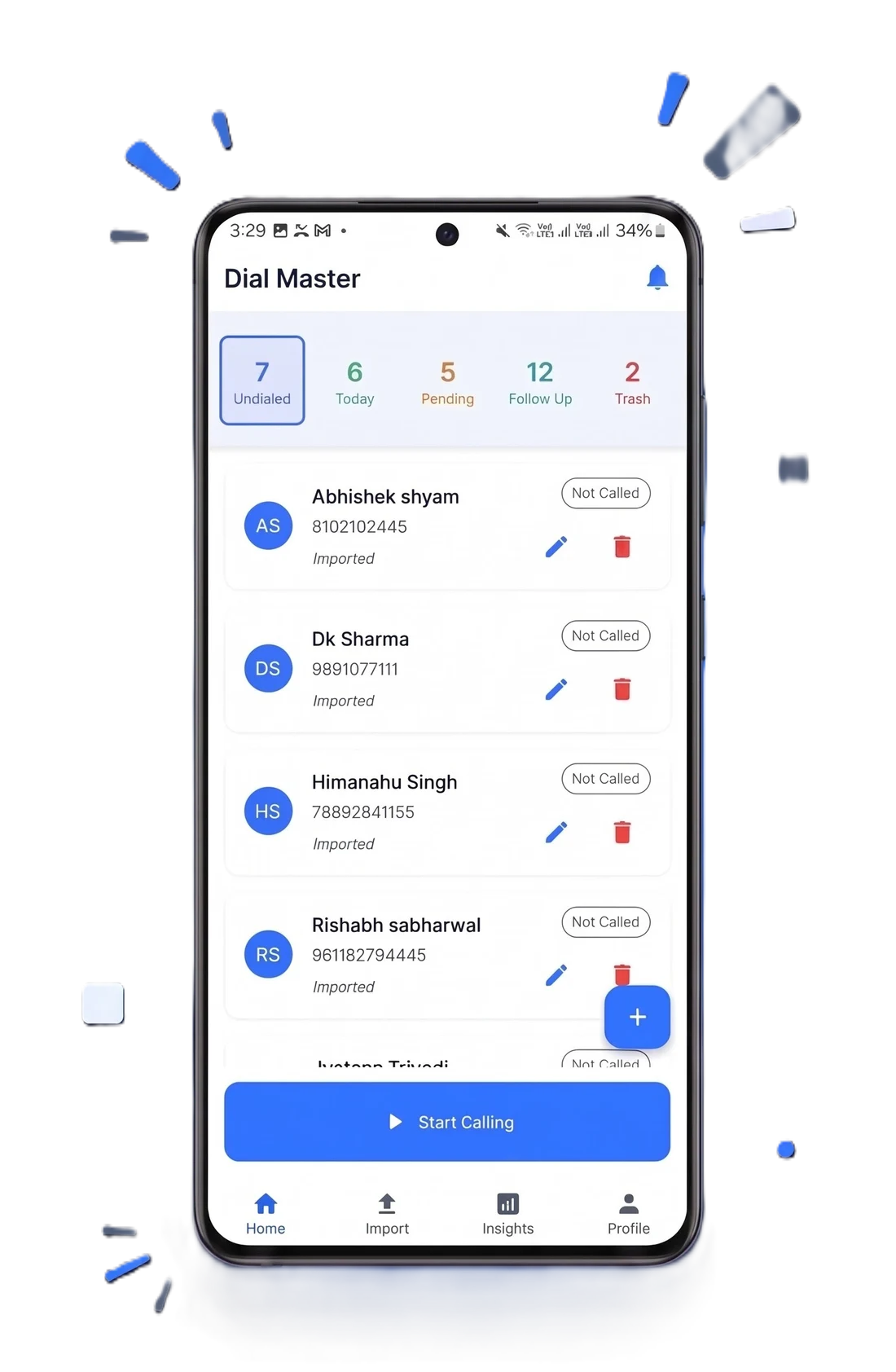
A working week for an independent agent
- Monday — triage. Weekend enquiries from the portals land in one list. Sort into hot, warm and cold; queue hot for the same day. Speed matters more than sorting sophistication here.
- Tuesday — call between inspections. Work the hot queue from the car. Every call gets an outcome before the next one starts, or the day's data is lost.
- Wednesday — vendor prospecting. Suburb-level outreach. This is the block that builds next quarter's listings and the first one to get skipped.
- Thursday — follow-up. Filter by tag rather than scrolling. Anything promised on Tuesday is due now.
- Friday — prepare the weekend. Open-home lists ready, callbacks dated, and anything that belongs in the agency CRM pushed across.
The discipline, not the software, is what produces the result. The software's only job is to make the discipline take less effort than not doing it.
Getting portal enquiries into a dialer
Both major portals route enquiries by email, and some accounts support partner APIs. The email path works universally.
- Forward portal enquiry alerts to an email parser. Any automation tool with an inbound parser will do.
- Map two fields only: name and phone. Everything else slows the setup and is not needed at dial time.
- POST to the dialer's webhook. One endpoint per portal so you keep attribution.
- Send a test enquiry before you rely on it. Every parser mis-maps something on the first attempt.
- Reconcile weekly against portal-reported enquiry counts. Parsers fail silently when a portal changes its email template, which they do.
The mechanics are the same as the Indian portal setup described in our portal integration guide.
Australian calling rules you have to work inside
Telemarketing in Australia is governed by the Do Not Call Register Act 2006 and the Telecommunications (Telemarketing and Research Calls) Industry Standard 2017. The calling windows are set by that standard and are not negotiable.
| Day | Permitted hours (the called party's local time) |
|---|---|
| Monday to Friday | 9:00 am to 8:00 pm |
| Saturday | 9:00 am to 5:00 pm |
| Sunday | No calls |
| National public holidays | No calls |
Two details catch people out. The hours follow the recipient's local time, which matters across Australian time zones. And there are conditions on identifying yourself and your purpose at the start of the call, and on honouring opt-outs.
Verify your own position: whether a call to someone who enquired about your listing is covered by an exemption depends on the specific facts, and it is not a question a marketing page should answer for you. Read the Do Not Call Register guidance and the Industry Standard itself, and take professional advice. This page is general information, not legal advice.
Privacy obligations run alongside this: handling contact data engages the Australian Privacy Principles, published by the OAIC.
The realistic recommendation
If you are an agency, keep the agency platform — nothing here replaces trust accounting or portal distribution, and treating a dialer as a substitute would be a serious mistake.
If you are an individual agent whose listings come from prospecting you personally do, the gap worth closing is the one between the calls you make and the record of what happened on them. A free tool that closes it costs nothing to test for a fortnight, and the test tells you more than any comparison page.
What to establish before you sign an agency platform
Because none of these vendors publish prices, the quote you receive is negotiated rather than listed — which means the questions you ask determine what you pay.
- Which modules are in the number, and which are extra? Trust accounting, property management and portal distribution are frequently priced separately. A quote for "the CRM" may not include the thing you actually needed.
- Is it per user or per office? This changes the maths entirely for a growing team, and the answer differs between vendors.
- What is the contract term and the exit notice? Real estate software contracts run longer than most SaaS. Ask before you are invested.
- Can you export listings, contacts and history yourself? Test it during the trial. An export that requires a support ticket is a migration you will postpone for years.
- What does onboarding cost, and is it optional? Implementation fees are common in this category and rarely volunteered.
- What happens to your data if you leave? Ask for the retention window in days, in writing.
The numbers an individual agent should track
Agency dashboards report on the agency. An individual agent needs four numbers, and none of them require a platform to produce.
| Number | What it tells you | What to do if it is low |
|---|---|---|
| Dials per week | Whether the habit exists at all | Fix the calendar before fixing anything else |
| Connect rate | Whether your list and timing are right | Change when you call, not what you say |
| Appraisals booked per 100 dials | Whether the conversation works | Now change what you say |
| Days since last contact, per lead | Where the pipeline is leaking | Re-queue anything past three weeks |
Most agents debug the third number and lose the majority of their result in the second. Separating them is the single most useful thing this list does.
Best practice: before changing any software, run two weeks of these four numbers on whatever you use now. Without a baseline, every subsequent comparison is a matter of opinion — and opinion is how agents end up paying for tools that changed nothing.
Prospecting habits that survive a busy week
- Block the calls, do not fit them in. A prospecting hour that moves for every other commitment stops existing within a fortnight.
- Call the recent enquiries first, always. Recency beats every other prioritisation signal available to an individual agent.
- Log the outcome before the next call starts. Anything you plan to write up later is written up never.
- Re-queue no-answers at a different hour. Not five attempts in the same slot on the same day.
- Keep vendor prospecting separate from buyer follow-up. They need different energy and mixing them degrades both.
Running two systems without creating two problems
The dual setup — agency platform as system of record, phone for daily prospecting — works well, but only if you decide up front how information moves between them. Teams that skip that decision end up maintaining both by hand and trusting neither.
- Decide what the agency platform must know. Usually: appraisals booked, listings won, and anything with a compliance dimension. Not every dial.
- Decide when it learns it. A fixed Friday sync beats an intention to update "as you go", because as-you-go across two systems is what nobody does.
- Keep contact ownership unambiguous. If a vendor exists in both places with different notes, one of them is wrong and you will act on the wrong one.
- Never split compliance records. Consent, opt-outs and DNC status live in one place only. Fragmenting them is the one version of this that genuinely backfires.
Done properly the phone becomes the working surface and the platform becomes the record — which is what most agents were improvising anyway, just without the outcomes being captured.
Pro tip: agree the sync rule with your principal or office manager before you start, not after. The objection to agents using their own tools is almost always about visibility, and a stated weekly sync answers it before it becomes a conversation.
Related: the mobile-only field sales playbook, real estate CRM fundamentals, real estate auto dialer, real estate solution, improving connect rates, pricing, and the free plan.
Stop manually dialing. Start closing.
Install DialMaster on your Android device and dial your first list in under five minutes. Free forever, no credit card, no VoIP bill — and your leads never leave your phone.