Zero Data Retention CRM: Future of Outbound Sales
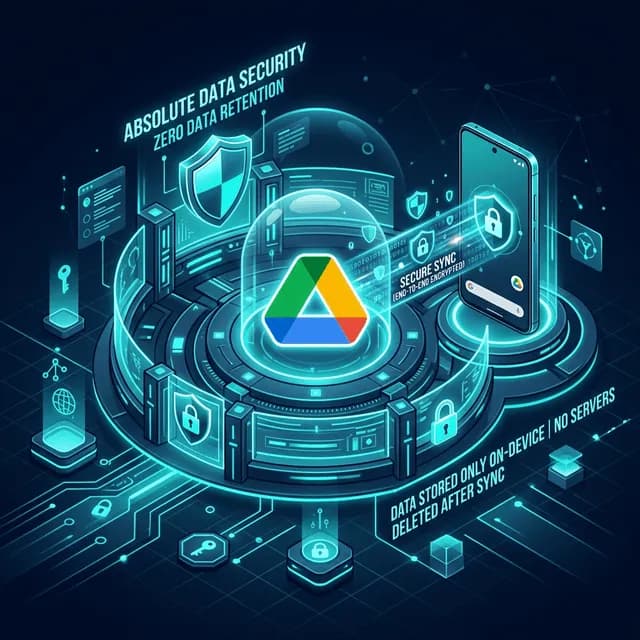
Traditional CRMs store your leads on hackable servers. Learn why DialMaster's Zero Data Retention architecture with Google Drive sync is safer.
TL;DR
Direct answer: A zero-data-retention CRM keeps your contact list on your own device rather than on a vendor's servers. The trade is deliberate: you give up automatic cross-device sync, and you gain the guarantee that a breach of the vendor cannot expose your leads, because the vendor never held them in the first place.
In 2024, IBM's Cost of a Data Breach report revealed that the average data breach costs a company $4.88 million. For small businesses, a single breach can be existential. Yet every time you upload a lead list to a cloud CRM like Salesforce, HubSpot, or Zoho, you are surrendering custody of your most valuable business asset — your prospect database — to a third party's servers.
A Zero Data Retention CRM is an architectural paradigm where the software provider deliberately refuses to store, process, or hold proprietary user lead data on their own centralized backend servers. Your data never leaves your device and your Google Drive. If the CRM company is breached, your leads are not compromised — because they were never on the CRM company's servers in the first place.
Traditional CRM vs Zero Data Retention: Architecture Comparison
| Factor | Traditional Cloud CRM | Zero Data Retention (DialMaster) |
|---|---|---|
| Data Storage Location | Vendor's AWS/Azure servers | Your device + your Google Drive |
| Vendor Can Access Your Data | Yes (admins, support staff) | No (physically impossible) |
| Breach Risk | High (centralized honeypot) | Minimal (decentralized) |
| Data Portability | Export request required | Already in your Google Sheets |
| Vendor Lock-In | High (switching cost) | Zero (you own the data natively) |
| Regulatory Compliance | Shared responsibility | Full user control |
Who Needs Zero Data Retention?
This architecture is critical for any organization handling sensitive Personally Identifiable Information (PII):
- Insurance Brokers: Managing policyholder details, health information, and financial records. A breach of this data carries regulatory penalties under IRDAI in India and HIPAA in the US.
- Real Estate Firms: Holding ultra-high-net-worth investor contacts and property transaction details. Leaked investor databases can lead to fraud and reputational devastation.
- B2B SaaS Startups: Guarding enterprise prospect lists that took months of research to build. Competitors would pay heavily for your qualified lead database.
- Healthcare & Education: Patient records, student information, and admission inquiry data carry strict privacy obligations under laws like DPDPA (India), GDPR (EU), and FERPA (US).
- Legal Firms: Client contact details, case references, and privileged communication must remain under the firm's exclusive control at all times.
How DialMaster's Google Drive Sync Works
Instead of hoarding your data on AWS buckets, DialMaster operates as a localized edge application on your Android device. Here's the exact data flow:
- Local Execution: All lead processing, auto-dialing, and CRM operations happen on your phone's processor. No server round-trips.
- Private Sync: When a call concludes, the disposition (Answered, Voicemail, DND) and your notes sync directly to a private Google Sheet hosted exclusively within YOUR Google Drive account.
- Zero Interception: DialMaster engineers have zero capability to read, access, or sell your leads because the data physically resides on Google's encrypted infrastructure, secured behind your own Google Workspace passwords and 2FA.
- Automatic Backup: Google Drive provides native version history, allowing you to restore lead data from any point in time without paying for a separate backup service.
Regulatory Compliance Benefits
Zero Data Retention architectures simplify compliance with the world's major data protection regulations:
- India's DPDPA (Digital Personal Data Protection Act, 2023): Requires data processors to delete personal data upon withdrawal of consent. With Zero Data Retention, there's nothing to delete from the vendor's servers — it was never there.
- EU GDPR (Article 17 - Right to Erasure): Data subjects can request deletion of their personal data. With DialMaster, you simply delete the row in your Google Sheet — no need to submit a deletion request to a CRM vendor.
- US CCPA/CPRA (California): Consumers have the right to know what data businesses collect about them. With Zero Data Retention, no third-party vendor holds the data, simplifying your disclosure obligations.
The Vendor Lock-In Trap
Beyond security, Zero Data Retention eliminates the most insidious problem in SaaS: vendor lock-in. Traditional CRMs make it deliberately difficult to export your data. Salesforce exports require Enterprise-tier access. HubSpot exports come in proprietary formats that lose relationships and metadata. Zoho exports are incomplete without manual reconstruction.
With DialMaster, your data already lives in Google Sheets — the world's most universally compatible format. If you ever decide to switch CRMs, your data is already portable. No export requests, no waiting periods, no data loss.
Conclusion: Own Your Data or Lose It
What "we don't store your data" has to mean to be worth anything
Every CRM vendor has a privacy page. Almost none of them are making the claim that matters, which is not we protect your data but we never receive it. Those are different promises with different failure modes, and only one of them survives the vendor being breached.
The distinction is testable. If a vendor can show you your contact list in their web dashboard, they hold it. If their support team can look up a record to help you, they hold it. If a subpoena to the vendor would produce your customer list, they hold it. Encryption at rest does not change any of those answers — it changes who can read the copy, not whether a copy exists.
- Encrypted at rest — they hold your data, in a form they can decrypt.
- We never sell your data — a policy commitment, revocable by a policy change.
- SOC 2 certified — their processes are audited. They still hold the data.
- Stored on your device only — the only one of the four that is an architectural fact rather than a promise.
The honest cost of holding nothing
An architecture that never receives your data cannot restore it either. That is not a caveat buried in a footnote, it is the direct consequence, and any vendor claiming both device-only storage and effortless recovery is describing two things that cannot be simultaneously true.
On a device-only plan, losing or wiping the phone loses the pipeline. There is no support ticket that recovers it, because there is nothing on our side to recover from. Decide deliberately whether that trade is right for your business rather than discovering it after the fact.
The resolution is not to abandon the principle — it is to make the backup an explicit, encrypted, opt-in choice rather than a default nobody was told about. That is what the upcoming cloud backup plan does, and why it is the paid tier rather than a feature bolted onto free.
Why this matters more for outbound calling than for most software
A contact database in a sales tool is not a list of names. It is a list of people who have not yet agreed to anything, annotated with what you learned about them, when you called, and what they said. In most jurisdictions that is personal data you are accountable for regardless of who is storing it.
Under India's data-protection regime and the GDPR alike, the obligation follows you, not the vendor. Choosing an architecture where the data never leaves the device removes an entire category of exposure — you cannot suffer a vendor breach of data a vendor never had.
How to verify a vendor's claim in ten minutes
- Ask where your contacts are queryable. If the answer includes a web dashboard, they are stored server-side. That is not disqualifying — it just means the claim is about protection, not absence.
- Ask what support can see. "Our team can look up your records to help" and "we don't store your data" cannot both be true.
- Read the sub-processor list. Every party listed is a party that touches your data. A short list is a real signal.
- Test the export. A vendor that makes export slow or partial is telling you something about lock-in.
- Check what happens on account deletion. Look for a stated retention window in days, not "in accordance with our policies".
The Question to Ask Any Vendor About Your Data
Privacy pages describe intentions. These four questions get at architecture, which is the part that survives a change of management.
- Where is the data physically stored, and who can read it? "Encrypted" is not an answer if the vendor holds the key — it means encrypted from everyone except them.
- What happens to it if I stop paying? Ask for the export before you sign. A vendor whose export path is awkward has told you their retention strategy.
- Who else has access? Sub-processors, analytics partners and support tooling all count. The answer is rarely "nobody", and the useful version is a list.
- What is the blast radius of a breach at your end? If the answer includes your customer list, you have taken on a risk you did not create and cannot control.
Device-only storage answers all four the same way — the vendor never holds it, so there is nothing to disclose, sell, or lose — but that is a real trade rather than a free win. You are accepting the risk of losing the phone in exchange for removing the risk of losing the vendor. Which of those you would rather own is a genuine business decision, not a technical one.
Where device-only is the wrong choice
It genuinely is, for some teams, and pretending otherwise would be selling rather than explaining.
- You need manager visibility across a team. Shared oversight requires shared storage.
- Agents change devices often. Every handset swap is a migration.
- You need centralised audit trails. Compliance reporting needs a server-side record.
- You have a formal data-retention obligation. Some regimes require you to keep records you would be unable to produce.
Related: how offline-first storage works, our data safety declarations, and TRAI rules on consent evidence.
In an era of escalating data breaches, tightening regulations, and increasing CRM vendor costs, Zero Data Retention isn't just a security feature — it's a business survival strategy. Your lead database is your company's most valuable asset. It should live under your control, protected by your security, and accessible on your terms.
Stop manually dialing. Start closing.
Install DialMaster on your Android device and dial your first list in under five minutes. Free forever, no credit card, no VoIP bill — and your leads never leave your phone.